South Africa · Cash-pay & group practices
One workspace for your South African cash-pay group. Without percentage fees or tool sprawl.
Replace the patchwork of personal WhatsApp phones, EFT proof-of-payment checks, unvetted associate AI scribes, and manual self-claim receipts. Give practice coordinators clean ZAR finance visibility while every clinician stays in charge of care.
Plan a 30-day pilot with 2 to 4 volunteer clinicians
Therapist-supervisedRisk screening on every messageGDPR compliantBuilt for HIPAA-regulated practicesTrust & Safety
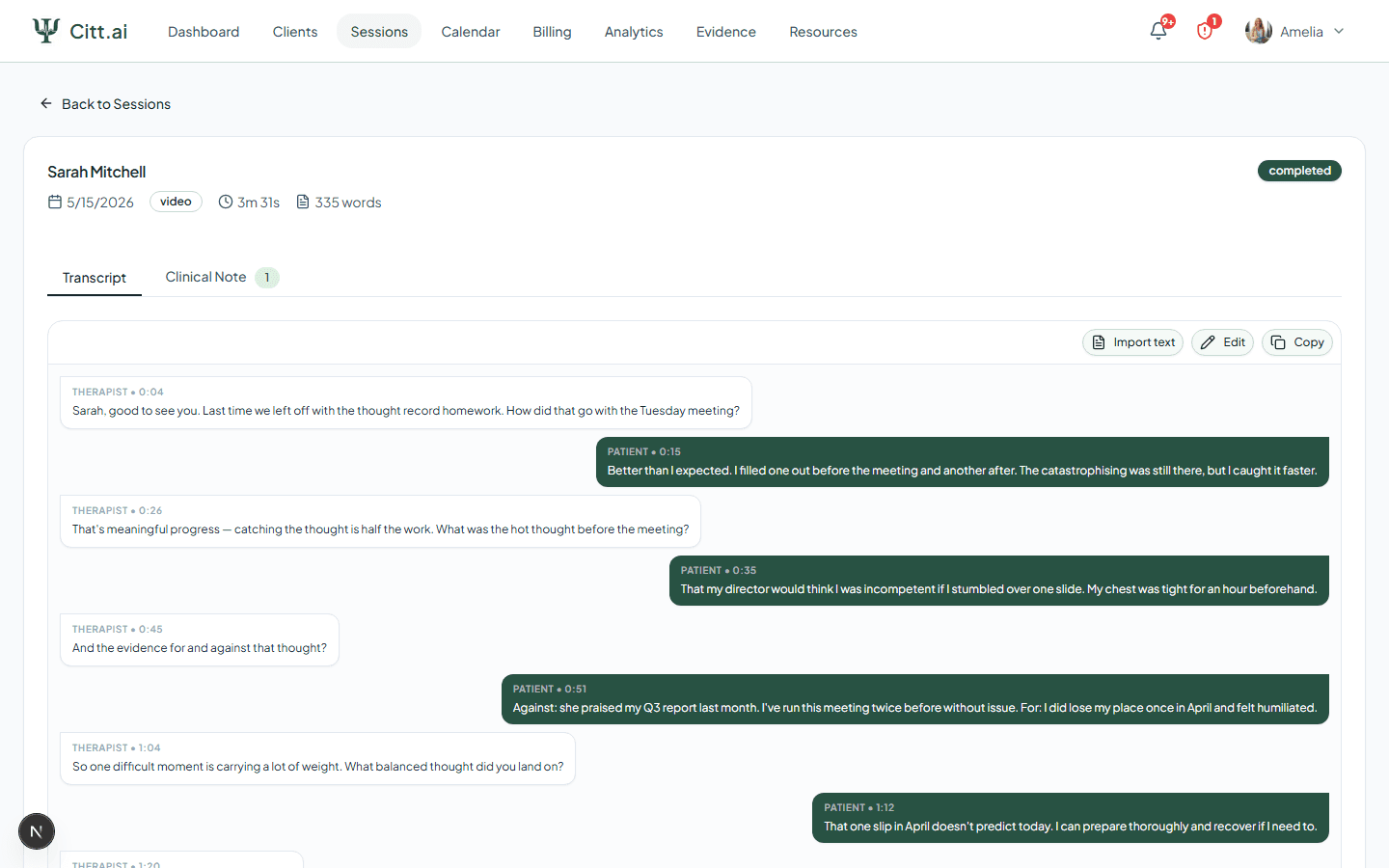
Outgrowing the patchwork
What changes when billing, notes, and WhatsApp share one record.
Most growing cash-pay practices in Johannesburg, Cape Town, Pretoria, and Durban stitch together four separate tools. Citt brings daily practice operations and supervised client continuity into one clinician-led platform.
| Practice workflow | Typical cash-pay patchwork | With Citt |
|---|---|---|
| ZAR billing and self-claim receipts | Manual PDF invoices, chasing EFT proofs of payment over WhatsApp, or paying a percentage of monthly revenue to legacy switching software. | ZAR invoices and statements with BHF/PCNS, SAMA, and WHO ICD-10 fields, EFT bank details on PDFs, and Paystack Rand payment links with no percentage cut on session fees. |
| Associate AI notes and HPCSA Booklet 20 | Associates quietly run separate consumer AI tools or standalone scribes with inconsistent consent, weak audit trails, and generic medical templates. | One practice workspace where drafts stay drafts until signed with clinician initials and signature, edits preserve immutable history, and non-recorded reflections still draft clean notes. |
| Between-session WhatsApp communication | Personal clinician phones blur boundaries, reminders go out manually, and check-ins vanish into unsearchable chat threads. | Opt-in WhatsApp check-ins and PHQ-9/GAD-7 assessments delivered via Meta's WhatsApp Business API, screened for risk before every reply with SADAG (0800 567 567) signposting. |
| Practice finance vs clinical privacy | Shared folders and spreadsheets either expose private clinical notes to admin staff or leave owners blind to overdue accounts. | Application-enforced role walls: coordinators oversee practice-wide invoicing, overdue balances, and rosters while each psychologist sees only their assigned clinical caseload. |
| Client continuity when associates change | Clinical context lives in siloed Word documents, making handovers slow when an associate goes on leave or moves on. | Approved notes, assessments, and check-ins build a structured client timeline and pre-session summary inside the practice record. |
Governance and HPCSA Booklet 20
Clear role boundaries and human clinical accountability.
HPCSA Booklet 20 places final clinical accountability on the registered professional, alongside clear AI disclosure and strong privacy controls. Citt is built as a therapist-in-the-loop co-pilot: Citt Guide surfaces what needs attention next and Ask Citt responds when clinicians ask, while every clinical decision and chart signature stays human.
Practice owner and coordinator
Practice-wide invoicing, overdue account visibility, shared client registry, clinician assignments, tariff codes, and rollout settings.
Finance and operations stay separated from private session transcripts and clinical notes.
Associate psychologist or counsellor
Assigned caseload, calendar sync, session transcription or post-session reflections, personal or practice templates, and Citt Guide next actions.
Every AI draft requires explicit clinician review and signature before entering the client chart.
Invited adult client (strictly opt-in)
Own appointments, ZAR receipts, and optional web or WhatsApp check-ins, assessments, and supervised reflections.
Managed client records require zero client logins; AI chat and WhatsApp stay off until invited and consented.
Low-risk rollout
Prove it alongside your existing tools before moving the whole team.
Rip-and-replace software switches stall busy practices. Start with a small volunteer cohort, keep your current diary connected, and expand only once your clinicians feel the time back.
01
Load your tariffs, templates, and roster
Import your existing client list via CSV, enter your BHF/PCNS practice number and ZAR fee codes, and upload the note formats your clinicians already use.
02
Run a 30-day pilot with 2 to 4 volunteer clinicians
Start alongside your existing diary or accounting setup instead of forcing a practice-wide cutover. Test session notes, pre-session summaries, and ZAR invoicing on real workflows.
03
Expand across associates with clear governance
Bring the rest of your team onto one approved workspace with role-scoped access, QuickBooks Online invoice sync where used, and opt-in WhatsApp continuity per client.
Important scope notes for South African buyers
Cash-pay and self-claim today; MediKredit on the roadmap
Citt generates ZAR invoices and statements with BHF/PCNS, SAMA, and WHO ICD-10 fields for client self-claiming, plus opt-in Regulation 5 account PDFs and CSV batch exports for manual medical-aid submission. Direct electronic medical-aid switching and automated eRA remittances are not yet live.
WhatsApp consent, POPIA hosting, and safety boundaries
WhatsApp is optional per client and runs via Meta's WhatsApp Business API with the same pre-reply risk screening and SADAG (0800 567 567) crisis resources as web chat. Production data is hosted on AWS in London (eu-west-2) with audit logs and a Data Processing Agreement available on request. Citt is software, not an emergency or managed clinical service.
Group practice FAQ
Questions South African practice owners ask
Role permissions, rollout pace, HPCSA Booklet 20 governance, and medical-aid boundaries. See also Citt for South Africa and Trust & Safety.
Can practice coordinators manage billing without reading clinical notes?
Do we have to migrate our entire group off Bookem, Google Calendar, or spreadsheets on day one?
How does Citt prevent associate AI tool sprawl under HPCSA Booklet 20?
Do all clients in our practice have to use WhatsApp or AI chat?
What if some clinicians in our group handle medical-aid accounts alongside cash-pay clients?
Map a 30-day pilot for your South African practice.
Walk through your current templates, ZAR billing workflow, and associate setup with us, or review transparent plan tiers, independent practice capabilities, and AI therapy notes.
Plan a 30-day pilot with 2 to 4 volunteer clinicians
- Flat per-clinician group quotes
- Zero percentage fee on session invoices
- Coexists alongside your current calendar and tools